| Weekday Wisdom |
on innovation |
|
|
|
Innovation · Creative thinking
|
|
Why hello there Sebastian,
This week we're looking at reverse engineering: taking something that already works, pulling it apart to understand why, and using that to build something better and faster. It's one of the oldest shortcuts to a good idea, from the Romans copying a shipwrecked enemy warship to these three gloriously cheeky examples.
|
| 01 |
The humble jerry can.
Have you ever wondered why it's called a jerry can? Early in WWII, Allied fuel cans were flimsy tins that leaked and needed tools and a funnel to pour. The Germans had quietly perfected theirs: a tough 20-litre steel can, welded in two halves, with three handles so one person could carry two, an air pocket so it floated, and a spout that poured cleanly without spilling a drop. The Allies got hold of a few, copied them exactly, and named it the jerry can (Jerry being the wartime nickname for a German).
|
|
| 02 |
The Compaq clean room.
IBM had the whole PC market locked up, because it owned the BIOS, the guarded scrap of code that boots a computer up. Copy that legally and the monopoly was broken. So Compaq used a "clean room": one team studied IBM's secret code and wrote up what it did; a second team, sealed off so they never saw a line of it, rebuilt it from that description alone. That method became the blueprint for the entire PC-clone industry, and started an arms race: firms now scramble their code like spaghetti to make copying near-impossible.
|
|
| 03 |
The missile that flew home.
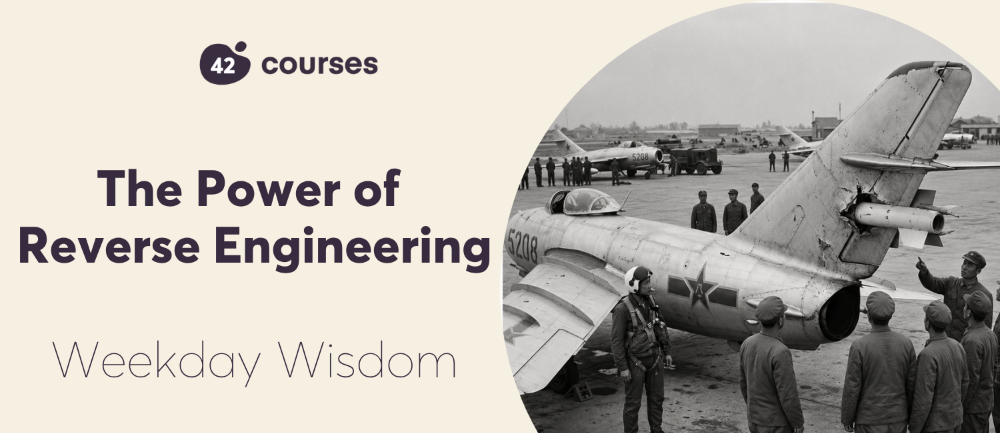
In 1958 a Taiwanese jet fired a top-secret American Sidewinder missile at a Chinese MiG. It struck, but didn't explode, lodging in the tail as the MiG limped back to base. The missile was handed to Soviet engineers, who reverse-engineered it so precisely that when US experts later examined the copy, they found the parts were interchangeable with the original.
|
|
|
The one to remember
Don't start with a blank page. Start with something that already works.
|
|
|
How to use it day to day
| • |
Deconstruct before you construct. Before the blank page, find three things that already nail it and pick apart why. |
| • |
Ask “why is that there?” Odd features usually solve a hidden problem. Assume it's deliberate until proven otherwise. |
| • |
Steal from other industries. Your answer may already exist somewhere unrelated. Teachers borrow from video games; F1 pit crews borrow from hospitals. |
|
|
|
|
Now go and take something apart.
Big love,
Chris & the 42courses team x
|
|
p.s. Spot something great this week, an ad, an email, a pitch. Don't just admire it, take it apart and see how it works.
|
|
|
 |
| Weekday Wisdom is a Tuesday habit from 42courses, where 50,000+ people in 160+ countries learn from working practitioners. |
Bonus dad joke
Q: What do you call a fake noodle?
A: An impasta. |
You are receiving this because you signed up for the 42courses newsletter.
Update your preferences or unsubscribe.
42courses · 7 Francis Grove · London, SW19 4DW · United Kingdom |
|